

Construction is the root of nearly every other point in the holiday lodge vs static caravan comparison. Everything else, from how it feels inside to how long it can stay on the pitch, follows from how the thing was built.
A static caravan is built on a steel chassis with lightweight walls, designed to be towed into place and to serve a summer season well. A holiday lodge is built to a residential-style specification, usually timber framed, with thicker walls, proper insulation and double glazing throughout.
Anyone weighing up holiday lodge vs static caravan should ask which standard a unit was built to. The construction standards are set out in British Standards for caravan holiday homes and park homes, and the National Caravan Council publishes guidance on what each classification means. If a park tells you a unit is a lodge, it is fair to ask for the detail.
Space and layout
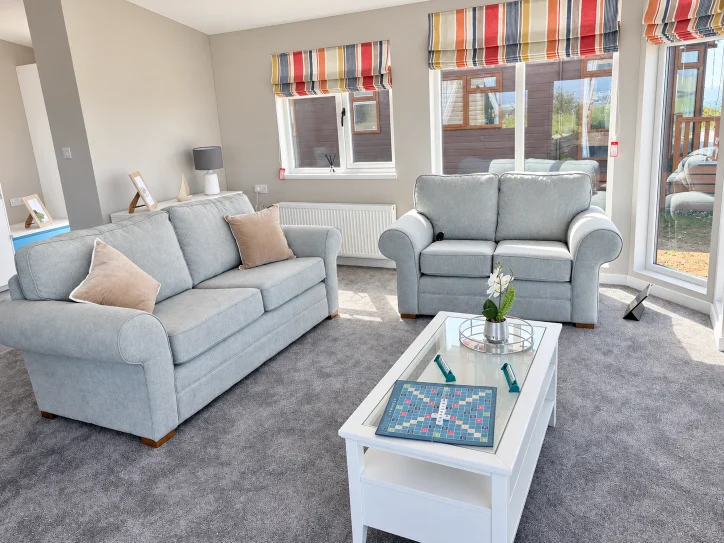
On holiday lodge vs static caravan, space is the difference you feel immediately. Lodges are simply bigger. A typical static caravan runs to around 12 feet wide, while lodges are commonly twin-unit and come in at 20 feet or more. That extra width changes the interior completely: open-plan living, a proper kitchen with full-size appliances, bedrooms you can walk around rather than shuffle through, and a bathroom with a real bath.
Ceilings tend to be higher in a lodge too, often vaulted, which is one of the reasons people walk into one and stop thinking of it as a caravan at all.
Year-round comfort

This is the holiday lodge vs static caravan difference owners notice most. Insulation and heating in a lodge are specified for cold weather, so a visit in January is genuinely comfortable rather than something you endure in a fleece. Central heating, thermostatic control and proper glazing make the lodge usable across a far longer season.
If you only ever intend to come down between May and September, a static caravan may serve you perfectly well. If you want the place to work at February half term, the question answers itself.
Permitted life and resale

Permitted life is the holiday lodge vs static caravan difference nobody thinks about until later. Parks apply age limits to units on their pitches, and lodges typically carry a longer permitted life than static caravans because of how they are built. That matters for two reasons: how long you can keep using it, and what it is worth if you ever come to sell it on.
Ask any park directly what the age policy is for each type of unit, and get the answer in writing rather than as a verbal reassurance.
Costs and letting appeal

On cost, holiday lodge vs static caravan is less clear cut than it looks. A lodge costs more to buy than a static caravan of the same age, but the running costs are closer than people expect, because better insulation offsets a good share of the larger footprint when it comes to heating. Site fees usually differ between pitch types, so compare the whole annual picture rather than the purchase figure alone. Our guide to holiday lodge running costs goes through every heading.
If you intend to let your lodge out when you are not using it, holiday lodge vs static caravan tilts further one way. Guests searching for a coastal break increasingly expect lodge-standard accommodation: space, a decent kitchen, a bath, decking and often a hot tub. A well-specified lodge tends to achieve a stronger nightly rate and a longer letting season. Letting income should never be treated as guaranteed, though, and neither a lodge nor a caravan on a holiday park can be used as a main residence.
Where the two really differ
- Build: timber framed and insulated, versus steel chassis and lightweight walls
- Width: around 20ft twin-unit, versus around 12ft
- Season: comfortable year round, versus best in summer
- Permitted life on the pitch: typically longer for a lodge
- Letting: stronger nightly rates and a longer season
- Resale: a longer permitted life supports onward value
Find us
Whitsand Bay Fort, Donkey Lane, Whitsand Bay, Torpoint, Cornwall PL10 1JZ
Common questions
Is a lodge just a big static caravan?
No. The build is different from the ground up. A lodge is usually timber framed and built to a residential-style specification, where a static caravan is built on a steel chassis to be towed into position.
Can I use a lodge in winter?
Yes. Insulation, glazing and central heating are specified for cold weather, which is why owners come down at February half term rather than waiting for Easter.
Which holds its value better?
Permitted life on the pitch is the main factor, and lodges typically carry a longer one. Ask any park for its age policy in writing before you buy either type.
Is a static caravan ever the better choice?
Yes, if your use is genuinely seasonal and budget is the main constraint. It is the lowest-cost route onto a park you love, and plenty of owners are very happy with one.
The honest advice is to view both in person on the same day. Photographs flatten the difference; standing in each one does not. Whitsand Bay Fort is a lodge park, so have a look at the current lodges for sale, read more about lodge ownership, or request a brochure.